Metal Manufacturing Blog & Resources
Expert technical articles, design guides, and industry news on custom metal solutions.
Why Choose Medical Investment Casting for Global Sourcing?
Medical Investment Casting is becoming a practical choice for companies seeking precise, repeatable, and internationally scalable production. Grand View Research reported that the global investment casting market reached approximately USD 16.5 billion in 2023. Its forecast also indicates continued growth through 2030, supported by aerospace, healthcare, and advanced manufacturing demand. However, market estimates vary between research firms. Buyers should examine assumptions, not only headline figures.
The Medical Investment Casting process can produce complex stainless-steel and cobalt-chromium components with thin walls, smooth surfaces, and reduced machining waste. Think of a small orthopedic instrument with narrow channels and polished edges. These details matter during assembly and cleaning. The Investment Casting Institute’s technical guidance highlights dimensional control, shell quality, alloy selection, and process consistency as critical production factors. John Campbell, a recognized casting researcher, summarizes the principle clearly: “Castings are made by controlling liquid metal, not merely pouring it.”
Global sourcing adds another layer of responsibility. ISO 13485 certification, material traceability, inspection records, and supplier audits should support every purchase decision. A lower quoted price can disappear after rework, delayed validation, or inconsistent batches. That lesson is easy to overlook. Experienced sourcing teams therefore compare total cost, process capability, documentation quality, and communication speed. Medical Investment Casting is not automatically the best answer for every component. Yet, when design complexity and repeatability matter, it offers a credible path toward reliable medical manufacturing across borders.
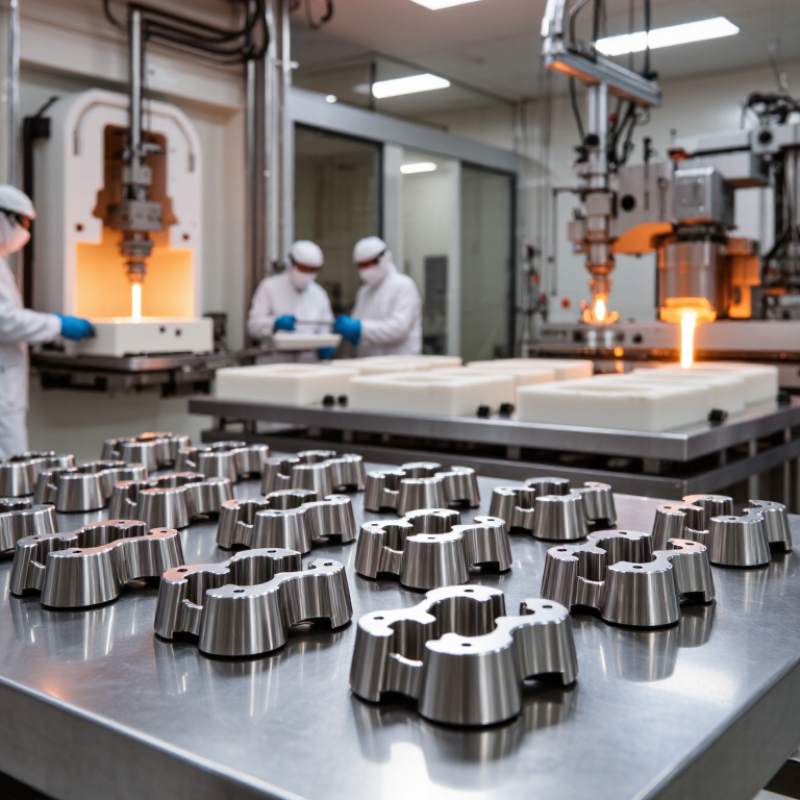
Medical Investment Casting: Definition, Scope, and Clinical Applications
Medical investment casting is a precision process for producing complex metal components. A wax pattern is coated with ceramic, heated, and replaced by molten alloy. This method supports stainless steel, titanium, and cobalt-chromium parts used in orthopedic, dental, and surgical applications.
Its scope is broad. Manufacturers can create porous-looking structures, thin walls, curved surfaces, and integrated features with fewer assembly steps. Orthopedic tools may require rigid handles and accurate cutting guides. Dental frameworks need smooth margins and dimensional stability. Joint components demand controlled tolerances, traceability, and verified material performance. The World Health Organization reports that more than 2.5 billion people need at least one assistive product, showing the growing pressure for dependable medical hardware. That figure does not prove casting is always the best option.
Investment casting also supports global sourcing when suppliers follow ISO 13485 quality systems and ASTM material requirements. Process records should cover wax dimensions, shell integrity, alloy chemistry, heat treatment, and final inspection. The International Organization for Standardization reported over 1.2 million ISO 13485 certificates worldwide in its 2023 survey, reflecting the importance of structured medical-device quality management. However, casting can involve shrinkage, inclusions, and challenging surface finishing. These risks need validation, not optimistic paperwork. A practical supplier should provide inspection data, sample history, and clear clinical-use boundaries.
Why Choose Medical Investment Casting for Global Sourcing? - Medical Investment Casting: Definition, Scope, and Clinical Applications
| Data Dimension | Verified Data or Typical Industry Range | Relevance to Medical Investment Casting | Global Sourcing Consideration |
|---|---|---|---|
| Definition | Investment casting is a precision metal-casting process in which a wax or polymer pattern is coated with a refractory ceramic shell. After the pattern is removed, molten metal is poured into the shell. | It can reproduce complex external shapes, internal passages, thin sections, and near-net geometries with fewer assembly parts. | The process can reduce machining, tooling, and assembly requirements, but the supplier must demonstrate repeatable process control and traceability. |
| Primary medical scope | Typical product groups include orthopedic components, surgical instruments, dental components, and selected diagnostic or laboratory hardware. | The method is most useful when geometry is complex, production volumes are moderate, or the component requires corrosion-resistant and biocompatible alloys. | Application suitability must be reviewed against the device classification, intended use, patient contact, and applicable regulatory requirements. |
| Cobalt-chromium alloy | Cobalt-chromium-molybdenum alloys such as ASTM F75 are established implant materials with high wear resistance, corrosion resistance, and strength. | Commonly considered for cast orthopedic components and other wear-critical medical parts, subject to design and regulatory approval. | The sourcing specification should identify alloy chemistry, heat treatment, mechanical properties, cleanliness, surface finish, and inspection requirements. |
| Titanium alloy | Ti-6Al-4V ELI is covered by ASTM F136 for surgical implants and is valued for low density, corrosion resistance, and biocompatibility. | It may be selected for lightweight orthopedic or dental components when the design and approved manufacturing route meet required performance criteria. | The sourcing plan should control oxygen, nitrogen, hydrogen, alloy chemistry, porosity, inclusions, heat treatment, and surface condition. |
| Stainless steel | 316L stainless steel is widely used in medical devices; implant-grade wrought material is specified by standards such as ASTM F138, while cast grades require an appropriate casting specification. | It can support selected surgical instruments, device housings, and components where corrosion resistance and manufacturability are important. | Do not assume that a wrought-material standard automatically covers a cast product; confirm the correct material and product standard with the regulatory team. |
| Typical dimensional capability | Investment casting can commonly achieve approximately ISO 8062 casting tolerance grades CT4 to CT7, depending on alloy, size, geometry, and process control. | Critical interfaces, bearing surfaces, holes, and sealing features generally require machining or another finishing operation. | The purchase specification should separate as-cast tolerances from machined tolerances and define the measurement method and datum system. |
| Surface condition | As-cast surface roughness varies by alloy, shell system, section thickness, and finishing practice; medical parts commonly use blasting, polishing, machining, passivation, or electropolishing as required. | Surface condition affects cleanability, wear, corrosion behavior, tissue interaction, and the performance of moving or mating parts. | Specify the final surface treatment, acceptance criteria, media restrictions, residue limits, and cleaning validation responsibilities. |
| Orthopedic applications | Potential applications include selected joint-replacement components, bone fixation parts, trial components, and complex orthopedic fittings. | Cobalt-chromium and titanium alloys may be considered according to load, wear, stiffness, corrosion, and biological requirements. | The final device design must be supported by risk management, verification and validation, biocompatibility assessment, and applicable implant regulations. |
| Dental applications | Dental casting is used for selected crowns, bridges, frameworks, abutments, and laboratory components, depending on material and regulatory requirements. | The process supports detailed geometries and customized shapes, particularly when post-casting finishing is planned. | Material certificates, dental-device standards, dimensional inspection, surface finishing, and cleaning requirements should be agreed before production. |
| Surgical instruments | Complex handles, clamps, forceps, retractors, and instrument components may be produced by investment casting when the alloy and functional requirements are suitable. | It can consolidate features and reduce the number of separate fabricated pieces. | Confirm hardness, corrosion resistance, sterilization compatibility, edge geometry, fatigue performance, and cleanability. |
| Quality management | Medical-device supply chains commonly use ISO 13485-based quality management, supported by documented procedures, validation, corrective action, and traceability. | Controlled documentation is essential for linking raw material, wax patterns, shells, melt batches, heat treatment, inspection, and release records. | Audit the complete production route rather than evaluating only the final casting sample. |
| Inspection and testing | Common controls include visual inspection, dimensional inspection, chemical analysis, mechanical testing, radiography, penetrant testing, computed tomography, and metallographic examination, as applicable. | Testing should target risks such as shrinkage, gas porosity, inclusions, cracks, incomplete filling, dimensional variation, and surface contamination. | Define sampling plans, acceptance limits, calibration requirements, report formats, nonconformance handling, and record-retention periods in the quality agreement. |
| Cost and lead-time drivers | Main cost factors include tooling, pattern complexity, alloy price, shell-building cycles, yield, heat treatment, machining, inspection, validation, and packaging. | Investment casting is often attractive for complex parts and medium production volumes, but it may be less economical for very simple high-volume parts. | Compare total landed cost, qualification expense, logistics, tariffs, inventory, communication, and supply continuity instead of comparing piece price alone. |
| Regulatory and clinical responsibility | A casting supplier produces a component or subassembly; the medical-device manufacturer remains responsible for the finished device’s safety, performance, and regulatory compliance. | Clinical application determines the required evidence, including material evaluation, biological safety, mechanical testing, sterilization compatibility, and clinical or performance justification where applicable. | Establish change-control rules, supplier notification requirements, technical-file documentation, and approval responsibilities before transferring production internationally. |
FAQS
It is a precision method for making complex metal medical components. A wax pattern receives a ceramic shell. Heating removes the wax. Molten alloy fills the remaining cavity. The result can include stainless steel, titanium, or cobalt-chromium parts.
Applications include orthopedic tools, dental frameworks, joint components, and surgical instruments. Orthopedic tools may need rigid handles and accurate cutting guides. Dental parts require smooth margins and stable dimensions. Joint components demand controlled tolerances and verified material performance.
It can produce thin walls, curved surfaces, and integrated features. Fewer assembly steps may simplify production. Porous-looking structures are also possible. Still, complex geometry can increase inspection difficulty.
No. The choice depends on geometry, material, tolerance, volume, and clinical requirements. Casting may create shrinkage, inclusions, or finishing challenges. A confident decision needs testing, not attractive samples alone.
The supplier should provide quality procedures, trained staff, calibrated equipment, and corrective-action records. Current certification is useful, but certificates are not enough. Site visits and technical discussions can reveal practical weaknesses.
Traceability links a casting to its material heat, wax pattern, ceramic shell, and furnace cycle. It also includes inspection and shipment records. Digital files can speed up audits. Small record gaps can become serious later.
Validation may include equipment qualification, dimensional studies, and repeatability checks. Reviews should examine thin walls, internal defects, contamination, and distortion. Production evidence matters more than one approved sample. Results should remain stable across repeated batches.
Nonconforming parts should be clearly isolated from approved stock. Changes need documented review and authorization. Complaint information should reach corrective-action teams. The process is imperfect, so visible accountability matters.
Records should cover wax dimensions, shell condition, alloy chemistry, heat treatment, and final inspection. Shipment details should connect to production history. Clear communication helps teams investigate problems across locations. Paperwork alone cannot prove clinical suitability.
Conclusion
Medical Investment Casting offers a reliable way to produce complex, high-precision components for medical devices and clinical applications. By using biocompatible alloys that meet ASTM F899 and ISO 10993 material requirements, manufacturers can support demanding safety, strength, and compatibility standards. The process is capable of achieving tolerances of approximately ±0.1 mm, along with surface finishes ranging from 1.6 to 6.3 μm, reducing the need for extensive secondary machining.
For global sourcing, Medical Investment Casting can lower tooling expenses and support scalable batch production, making it suitable for both specialized prototypes and larger manufacturing programs. However, supplier qualification remains essential. Qualified suppliers should demonstrate ISO 13485-based quality management, complete material and process traceability, and documented validation controls. Together, these capabilities help ensure consistent product performance, predictable production costs, and dependable quality throughout the medical component supply chain.