Metal Manufacturing Blog & Resources
Expert technical articles, design guides, and industry news on custom metal solutions.
Modern farms depend on small metal parts that rarely attract attention. Trellis hooks, livestock-panel clips, crop-support frames, and protective guards must withstand rain, vibration, soil, and repeated handling. Custom Agricultural Wire Forming turns standard wire into precise, application-specific components. The right manufacturer can improve assembly speed, field reliability, and maintenance control.
Industry evidence supports this focus on practical automation. FAO’s The State of Food and Agriculture 2022 explains how agricultural automation can raise productivity and reduce physically demanding work. The OECD-FAO Agricultural Outlook 2024-2033 also emphasizes efficiency, resilient supply chains, and smarter input use. These priorities affect every wire component, even a simple bent hook. A weak bend may open under load. Poor coating may fail after one wet season. Small errors become expensive at scale.
This guide examines leading manufacturers through engineering capability, material knowledge, forming accuracy, tooling support, and quality systems. Grand View Research and MarketsandMarkets reports on metal forming and agricultural equipment also point toward growing demand for customized, durable production solutions. However, market rankings are never perfect. A large supplier may lack flexibility. A smaller specialist may offer better samples and faster design feedback. Experience matters here. Ask for material certificates, tolerance data, corrosion-testing methods, and production samples before choosing a partner. Look closely. The best supplier is not always the most visible one. It is the manufacturer that understands field conditions and delivers consistent parts when the order becomes difficult.
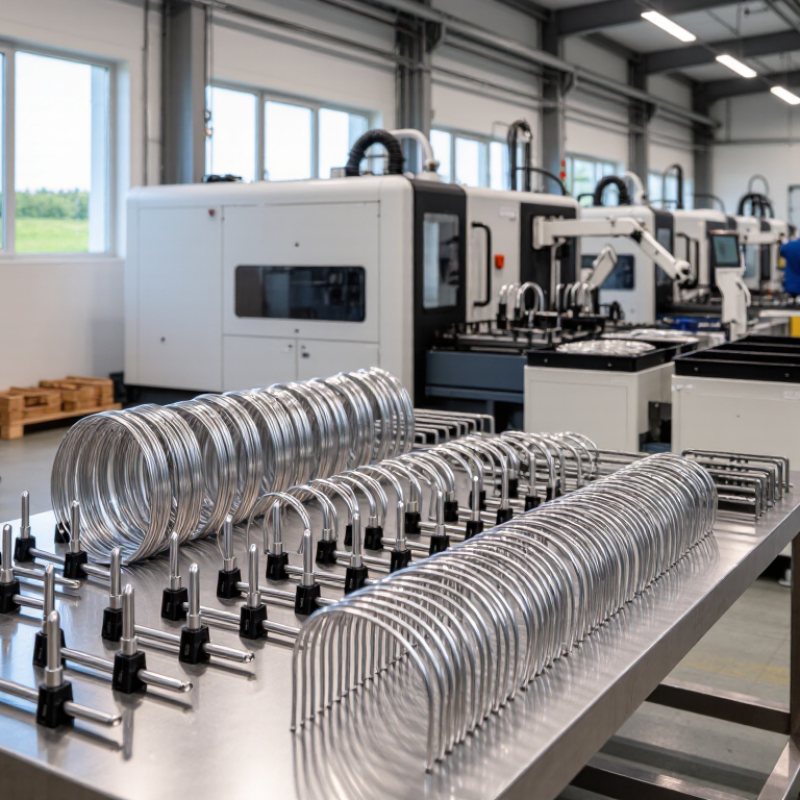
Definition and Role of Custom Agricultural Wire Forms
Custom agricultural wire forms are shaped metal components designed for specific farm tasks. They support crops, guide animals, secure panels, and organize irrigation lines. Unlike standard wire, each form can match a required length, bend, diameter, and load capacity.
Their role becomes clearer on working farms. A formed wire clip may hold greenhouse film against wind. A trellis hook can keep tomato stems away from wet soil. In livestock areas, reinforced loops can secure gates without sharp exposed ends. The United States Department of Agriculture’s 2022 Census of Agriculture recorded nearly 1.9 million farms. That scale creates many different equipment needs. One universal wire shape cannot serve every field effectively. FAO’s AQUASTAT data also shows agriculture uses about 70% of global freshwater withdrawals. Custom forms can help route irrigation tubing neatly and reduce avoidable damage, although wire alone cannot solve water waste.
Tips: Specify the working load, corrosion exposure, wire diameter, and bend radius before production. Test samples in real conditions, not only in a workshop. Small details matter. A tight bend may weaken the metal, while a loose fit can cause movement. Engineers should review coating choices, contact points, and cleaning access. The design may look simple, but field failures often begin with incomplete measurements. One overlooked seasonal change can expose that weakness.
| Custom Wire Form Category | Common Material | Typical Wire Diameter | Relevant Material or Product Standard | Typical Agricultural Applications | Primary Functional Role | Important Customization Factors |
|---|---|---|---|---|---|---|
| Trellis Hooks and Clips | Low-carbon steel, galvanized steel, or stainless steel | Approximately 1.5–4.0 mm | ASTM A641 for zinc-coated carbon steel wire; ASTM A580 for stainless steel wire | Vineyards, orchards, berry supports, and greenhouse crops | Secures stems, vines, and support lines while allowing controlled plant movement | Loop diameter, opening size, spring action, coating thickness, and corrosion exposure |
| Crop Support Rings | Galvanized carbon steel or stainless steel | Approximately 2.0–5.0 mm | ASTM A641 or ASTM A580, depending on the selected material | Tomatoes, peppers, ornamental plants, and nursery production | Maintains plant shape and distributes support around stems and branches | Ring diameter, opening geometry, load requirement, edge safety, and surface finish |
| Livestock Panel Hooks | High-tensile carbon steel or galvanized steel | Approximately 3.0–8.0 mm | ASTM A641 for galvanized carbon steel wire; application-specific structural requirements may also apply | Cattle panels, sheep fencing, poultry enclosures, and temporary pens | Joins or locks wire panels and helps maintain enclosure alignment | Hook throat width, closing force, tensile strength, coating durability, and panel wire size |
| Fence Strainers and Tensioning Forms | Galvanized carbon steel or stainless steel | Approximately 3.0–10.0 mm | ASTM A641 for galvanized wire; ASTM A580 for stainless wire components | Perimeter fencing, field boundaries, orchard fencing, and livestock systems | Maintains wire tension and reduces sag over long fence runs | Torque capacity, forming radius, anchor geometry, tensile loading, and environmental exposure |
| Irrigation Tube Clips | Stainless steel, galvanized steel, or spring steel | Approximately 1.0–3.0 mm | ASTM A580 for stainless steel wire; spring properties should be specified for reusable clips | Drip irrigation, micro-irrigation, nursery benches, and greenhouse systems | Positions tubing and prevents movement without requiring permanent fasteners | Tube outside diameter, clamping force, reusable-cycle requirement, and corrosion resistance |
| Harvest Basket and Bin Handles | Low-carbon steel, galvanized steel, or stainless steel | Approximately 3.0–8.0 mm | ASTM A580 for stainless steel; ASTM A641 for zinc-coated carbon steel wire | Fruit harvesting baskets, produce containers, and field transport bins | Provides a shaped carrying point and transfers load to the container body | Grip diameter, bend radius, handle span, load rating, end retention, and comfort |
| Greenhouse Plant Hangers | Galvanized steel, stainless steel, or polymer-coated steel | Approximately 2.0–6.0 mm | ASTM A641 for galvanized steel wire; coating specification should identify polymer type and thickness | Hanging baskets, vertical growing systems, and greenhouse equipment | Suspends containers, crop lines, and lightweight growing accessories | Working load, safety factor, hook opening, ceiling attachment, and coating compatibility |
| Beekeeping Frame Components | Stainless steel or tinned low-carbon steel wire | Approximately 0.4–1.0 mm | ASTM A580 for stainless steel wire; food-contact suitability should be confirmed where applicable | Beekeeping frames and foundation-support assemblies | Supports wax foundation and helps stabilize comb during handling | Wire gauge, straightness, corrosion resistance, eyelet compatibility, and tension retention |
| Seedling Tray Retainers | Galvanized steel, stainless steel, or coated spring steel | Approximately 1.5–4.0 mm | ASTM A641 for galvanized wire; stainless options may be specified to ASTM A580 | Nurseries, propagation benches, plug trays, and greenhouse production | Prevents trays and containers from shifting during watering, transport, or handling | Tray dimensions, spring-back, retaining force, release access, and repeated-use durability |
| Agricultural Machine Retaining Clips | High-carbon spring steel, stainless steel, or zinc-coated steel | Approximately 1.0–6.0 mm | Material and spring-performance requirements should be defined on the engineering drawing | Seeders, balers, harvesters, cultivators, and irrigation equipment | Retains pins, guards, covers, hoses, and removable machine components | Fatigue life, insertion force, vibration resistance, heat exposure, and dimensional tolerance |
| Custom Wire Guards | Galvanized steel, stainless steel, or polymer-coated steel | Approximately 2.0–6.0 mm | ASTM A641 for galvanized carbon steel wire; ASTM A580 for stainless steel wire | Tree guards, seedling protection, equipment guards, and animal-exclusion barriers | Creates a formed protective barrier around plants, cables, or small equipment | Guard height, mesh or loop geometry, clearance, opening size, impact resistance, and coating |
FAQS
Request material certificates, dimensional reports, process records, and batch traceability details. Clear records should identify wire grade, tensile strength, and coating thickness.
Photographs cannot show spring-back, sharp edges, or weak welds. Test three production samples under realistic loads and repeated bending conditions.
No. Certification shows a management system exists. It does not prove accurate forming, strong welds, or long field durability.
Confirm wire diameter, tensile strength, bend tolerance, coating thickness, and corrosion resistance. A small measurement error can affect frame alignment and installation speed.
Share drawings, load conditions, assembly methods, and expected annual volume. The manufacturer can then suggest wire grades, bending radii, and packaging methods.
Prototypes reveal tool marks, sharp edges, and difficult assembly points. Computer drawings may miss these problems. Samples expose gaps.
Review capacity records, equipment maintenance, staffing, packaging protection, and delivery history. A supplier may pass sample testing but struggle with monthly volume.
Check forming, welding, coating, and final packing inspections. Review rejected parts and corrective actions. Uncomfortable, but useful.
A low quote may reflect thinner coating, weaker wire, or incomplete inspection. The cheapest option is not always efficient.
Include specifications, inspection duties, delivery expectations, packaging methods, and replacement procedures. Communication matters when requirements change. Mistakes still happen.
Conclusion
Custom Agricultural Wire Forming refers to the design and production of shaped wire components created for specific farming and agricultural equipment needs. These forms can support planting systems, harvesting machinery, livestock facilities, irrigation structures, crop protection systems, and greenhouse installations. Common materials include carbon steel, stainless steel, and corrosion-resistant alloys, selected according to strength, flexibility, outdoor exposure, and operating conditions. Manufacturing may involve bending, cutting, welding, stamping, coating, and precision forming to achieve consistent dimensions and reliable performance.
When evaluating agricultural wire forming manufacturers, buyers should review material quality, production accuracy, tooling capabilities, inspection procedures, surface protection, and capacity for custom designs. A dependable supplier should understand agricultural applications and provide practical solutions that balance durability, cost, ease of installation, and maintenance. Quality standards, traceability, sample testing, and clear communication are also essential. By comparing customization support, delivery reliability, and technical service, agricultural businesses can select a manufacturing partner capable of producing safe, durable, and application-specific wire components for modern farming operations.