Metal Manufacturing Blog & Resources
Expert technical articles, design guides, and industry news on custom metal solutions.
China Top 10 Medical Sheet Metal Fabrication Manufacturers
Table of Contents
- What Is Medical Sheet Metal Fabrication?
- How Medical Sheet Metal Components Are Designed and Produced
- Key Standards for Medical Sheet Metal Manufacturing in China
- China’s Top 10 Medical Sheet Metal Fabrication Manufacturers
- How to Evaluate and Select a Suitable Manufacturer
- FAQS
- Conclusion
- Related Posts
China’s medical manufacturing sector has become a serious source of precision enclosures, instrument panels, chassis, brackets, and internal frames. This article examines the China Top 10 Medical Sheet Metal Fabrication Manufacturers through practical criteria. These include material traceability, CNC accuracy, clean production controls, welding quality, surface finishing, documentation, and medical-device experience.
Medical Sheet Metal Fabrication is not ordinary metalwork. A cabinet may protect sensitive electronics, while a small bracket can affect alignment, sterilization access, or operator safety. Stainless steel edges must feel smooth. Ventilation slots must remain consistent. Welds should resist corrosion after repeated cleaning cycles.
Dr. Jeff Shuren, former director of the FDA’s Center for Devices and Radiological Health, has emphasized, “Quality cannot be tested into a product; it must be built into the product.” That principle matters throughout supplier selection. A polished sample is not enough. Buyers should review inspection records, process controls, engineering communication, and change-management practices.
This ranking is intended as a useful starting point, not a permanent verdict. Supplier capabilities can change. Public information can also be incomplete. Some manufacturers may appear strong online but provide limited evidence of medical-sector performance. That deserves caution.
Look beyond price. Ask how each company handles thin-gauge distortion, tight tolerances, laser-cut burrs, EMI shielding, and packaging protection. The strongest suppliers usually combine experienced engineers, stable production teams, and disciplined inspection. They also admit problems early. That small habit can prevent expensive failures later.
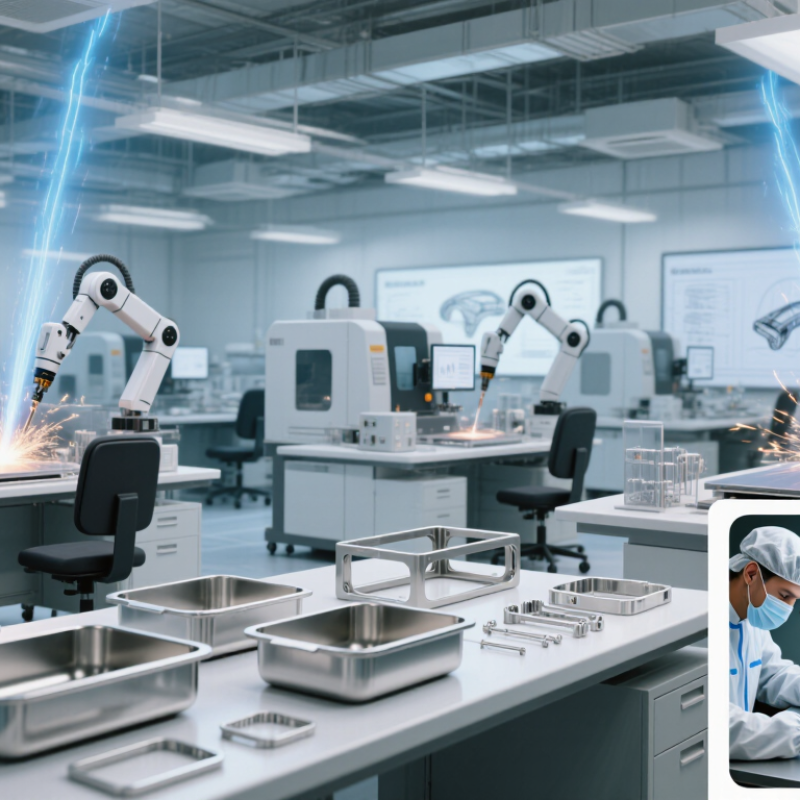
What Is Medical Sheet Metal Fabrication?
Medical sheet metal fabrication is the controlled process of turning flat metal sheets into components for healthcare equipment. These parts may include equipment housings, surgical instrument trays, cabinets, carts, and protective panels. Common materials include stainless steel and aluminum because they resist corrosion and support repeated cleaning.
The process usually involves laser cutting, punching, bending, welding, grinding, and surface finishing. Each step affects safety and performance. For example, a sharp internal edge can trap residue, while an uneven bend may prevent a door from sealing properly. Skilled fabricators check dimensions with calibrated tools and inspect welds for cracks, pores, and distortion. Surface passivation can improve stainless steel corrosion resistance, but it does not replace proper cleaning or design control.
Reliable production also requires material certificates, batch traceability, inspection records, and documented process changes. Quality systems aligned with recognized medical-device requirements help reduce variation, although certification alone cannot fix poor workmanship. In practical fabrication, small details matter: smooth corners, consistent gaps, clean welds, and protected fasteners. A polished surface is not automatically a safe one. That point is easy to miss. Some designs still create hidden cleaning problems, especially around hinges and overlapping panels. Engineers should review manufacturability, maintenance, and user handling before production begins. Mistakes can happen. Careful feedback and repeated inspection make the final component more dependable.
China Top 10 Medical Sheet Metal Fabrication Manufacturers — What Is Medical Sheet Metal Fabrication?
Medical sheet metal fabrication is the process of cutting, bending, forming, welding, and finishing metal parts used in medical equipment, including equipment enclosures, carts, cabinets, trays, and structural frames. Material selection depends on strength, corrosion resistance, weight, and cleanability.
The chart compares representative minimum yield-strength values for commonly fabricated medical-grade sheet materials. Actual performance varies by standard, thickness, temper, and supplier certification.
How Medical Sheet Metal Components Are Designed and Produced
Medical sheet metal components begin with clinical needs, not just a drawing. Engineers define load, cleaning methods, patient contact, and operating temperatures. They also review access for assembly and maintenance. Small oversights can create sharp edges or trapped residue.
Computer-aided designs specify material grade, thickness, bend radius, and tolerance. Stainless steel often suits enclosures, trays, and equipment frames. Aluminum can reduce weight where appropriate. Designers use bend allowances and flat-pattern calculations before cutting. Laser cutting creates precise profiles, while press brakes form consistent angles. Welded joints may require controlled heat input and careful finishing.
Clean surfaces matter. Very much. Manufacturers remove burrs, inspect welds, and verify dimensions with calibrated tools. Surface treatments must match the component’s intended environment. Production records should connect material certificates, inspection results, and operator checks. A first prototype may reveal unexpected springback, vibration, or difficult cleaning points. That feedback should change the design, not be hidden. No process is flawless. Experienced teams still question their assumptions, repeat critical measurements, and test assembled parts under realistic conditions. This practical discipline helps medical equipment remain durable, serviceable, and safe throughout repeated use.
Key Standards for Medical Sheet Metal Manufacturing in China
China Top 10 Medical Sheet Metal Fabrication Manufacturers should be assessed through measurable quality controls, not production capacity alone. The World Health Organization reports more than two million medical device types worldwide, grouped into over 7,000 categories. This variety demands disciplined material control and process validation. The ISO Survey 2023 recorded more than 30,000 ISO 13485 certificates globally, showing how widely quality systems are expected in this sector.
Key standards begin with ISO 13485 for documented medical device quality management. ISO 14971 supports risk management, while IEC 60601-1 may apply to electrical medical equipment enclosures. Fabricators should maintain heat numbers, supplier certificates, inspection records, and lot traceability. Drawings must specify tolerances, weld requirements, surface roughness, and allowable burrs. A clean-looking panel is not enough.
Details matter.
Stainless steel parts may require controlled passivation and verified cleaning. Aluminum enclosures need consistent coating thickness and grounding continuity. Inspection plans should include first-article checks, gauge calibration, and corrective-action records. China’s GB standards may support production, but export projects often require additional international compliance evidence. Audits should review actual shop-floor records, not only certificates. In practice, some suppliers still treat traceability as paperwork. That is a weakness worth challenging. The strongest manufacturers connect every finished enclosure to its material batch, operator, machine, and inspection result. According to experience with regulated fabrication, this evidence often separates a reliable partner from a merely capable workshop.
China’s Top 10 Medical Sheet Metal Fabrication Manufacturers
China’s Top 10 Medical Sheet Metal Fabrication Manufacturers represent a competitive group serving hospitals, laboratories, and medical equipment developers. Their work commonly includes stainless steel housings, equipment cabinets, instrument trays, control panels, and mobile cart frames. Strong manufacturers combine laser cutting, CNC bending, welding, grinding, and controlled surface finishing under one production system.
A reliable supplier should demonstrate practical experience with tight tolerances and cleanable designs. Engineers need to consider rounded corners, limited gaps, drainage paths, and smooth welds. These details reduce residue buildup during routine cleaning. Quality teams may use inspection records, material certificates, first-article checks, and traceability procedures. Some facilities also maintain ISO 13485-based quality systems, although certification alone does not prove manufacturing capability.
The best candidates communicate clearly before production begins. They review drawings, clarify tolerances, test prototypes, and identify risks in thin-gauge materials. They should explain how stainless steel, aluminum, or coated steel fits the application. Request evidence of similar projects, inspection methods, and packaging protection. Small scratches can damage confidence, even when dimensions are correct.
No supplier is flawless. Communication delays, tooling adjustments, or finish inconsistencies can still appear. A thoughtful buyer should evaluate corrective-action records, production capacity, and after-sales responsiveness. Factory visits or live video audits add useful evidence. Price matters, but medical fabrication depends more on repeatability, documentation, and disciplined process control.
| Rank | Manufacturer Profile | Primary Location | Medical Sheet Metal Capabilities | Common Materials | Typical Thickness Range | Quality and Compliance Coverage | Typical Applications | Production Strength |
|---|---|---|---|---|---|---|---|---|
| 1 | Profile A High-volume precision enclosure fabricator |
Yangtze River Delta | Laser cutting CNC bending TIG welding Powder coating | 304 stainless steel, 316L stainless steel, aluminum, galvanized steel | 0.8–6.0 mm | ISO 9001 quality systems; material traceability; dimensional inspection reports | Medical carts, equipment housings, diagnostic instrument cabinets | Prototype to mass production; repeat-order programs |
| 2 | Profile B Stainless-steel medical equipment specialist |
Pearl River Delta | Fiber laser cutting Precision forming Seam welding Brushing | 304/316 stainless steel, aluminum, cold-rolled steel | 0.6–4.0 mm | ISO 9001-based inspection; surface-finish control; weld visual inspection | Operating-room furniture, sterilization equipment, laboratory cabinets | Strong cosmetic finishing and stainless-steel fabrication |
| 3 | Profile C Low-volume and rapid-prototyping supplier |
South China | Rapid prototyping CNC punching Bending Assembly | Aluminum, stainless steel, mild steel, copper | 0.5–5.0 mm | First-article inspection; drawing revision control; RoHS material documentation | Diagnostic-device prototypes, instrument panels, test equipment | Fast engineering feedback and small-batch production |
| 4 | Profile D Electromechanical enclosure manufacturer |
East China | CNC turret punching Laser cutting EMI gasketing Box-build assembly | Galvanized steel, cold-rolled steel, aluminum, stainless steel | 0.8–3.0 mm | ISO 9001 quality management; incoming inspection; electrical continuity checks | Patient-monitoring cabinets, control panels, imaging-system enclosures | Integrated sheet metal, hardware insertion, wiring and final assembly |
| 5 | Profile E Clean-finish fabrication provider |
Coastal East China | Fine laser cutting Deburring Passivation support Protective packaging | 316L stainless steel, 304 stainless steel, aluminum | 0.8–3.0 mm | Surface cleanliness controls; batch identification; inspection records | Laboratory workstations, surgical-device covers, clean-area equipment | Suitable for visible parts requiring consistent surface quality |
| 6 | Profile F Large-format medical cabinet fabricator |
Central China | Large-panel cutting Heavy-gauge bending MIG welding Powder coating | Carbon steel, stainless steel, aluminum | 1.0–8.0 mm | Weld inspection; coating-thickness checks; load and fit verification | Hospital storage systems, mobile medical cabinets, equipment frames | Large welded structures and durable industrial finishes |
| 7 | Profile G Precision small-part supplier |
Yangtze River Delta | Micro laser cutting Fine blanking Small-part forming Tapping | Stainless steel, aluminum, brass, nickel-plated steel | 0.3–2.5 mm | Coordinate measurement; burr inspection; lot-level traceability | Instrument brackets, mounting plates, sensor covers, internal shields | High repeatability for small precision components |
| 8 | Profile H Medical furniture metalwork manufacturer |
North China | Tube and sheet fabrication Roll forming Welding Electrostatic coating | Stainless steel, mild steel, aluminum | 0.8–5.0 mm | ISO 9001-based process control; weld consistency checks; packaging inspection | Bedside tables, medical trolleys, treatment carts, support frames | Combined tube, sheet metal and furniture-component production |
| 9 | Profile I Export-oriented contract fabricator |
South China | Laser cutting CNC bending Hardware insertion Export packaging | Stainless steel, aluminum, galvanized steel, cold-rolled steel | 0.7–4.0 mm | ISO 9001 quality controls; supplier material certificates; pre-shipment inspection | Medical device chassis, laboratory equipment panels, diagnostic consoles | OEM/ODM support and international shipping coordination |
| 10 | Profile J Integrated fabrication and assembly supplier |
Southwest China | Sheet metal fabrication Welding Powder coating Final assembly | Stainless steel, aluminum, carbon steel | 0.8–6.0 mm | Process inspection plans; assembly verification; packaging and labeling controls | Medical device stands, equipment bases, service panels, protective covers | Single-source production from fabrication through assembly |
| Comparison dimensions are based on commonly disclosed capabilities and standard requirements in medical sheet metal fabrication. Certification scope, tolerances, materials and production capacity should be verified directly with each supplier before qualification or purchase. | ||||||||
How to Evaluate and Select a Suitable Manufacturer
Selecting among China’s top medical sheet metal fabrication manufacturers requires more than comparing unit prices. Fortune Business Insights valued the global medical devices market at USD 536.12 billion in 2023 and projects USD 799.67 billion by 2030. That growth increases pressure on suppliers to deliver stable quality, traceability, and shorter development cycles.
Request ISO 13485 certification, recent audit records, and a process map from raw material to final inspection. Check whether the factory controls laser cutting, bending, welding, passivation, and surface treatment internally. Ask for material certificates, calibration records, first-article reports, and dimensional data from actual medical projects. A capable manufacturer should explain tolerance risks clearly, not simply promise “zero defects.” Small details matter. Inspect sample corners, weld penetration, burr removal, and protective film.
The supplier should also support design-for-manufacturing reviews before production. Confirm equipment capacity, clean handling procedures, change-control rules, and nonconformance response times. ISO 13485 focuses on a controlled quality-management system, but certification alone does not prove strong shop-floor execution. Visit the facility when possible. Watch how operators identify parts and separate rejected components. My own evaluation would include a pilot batch, because polished presentations can hide inconsistent bending or delayed inspection records. Cost remains important, yet a low quotation may reflect thinner material, weaker documentation, or outsourced finishing. According to the 2024 Medical Device Engineering and Manufacturing Report, manufacturers continue seeking resilient supply chains and qualified production partners, making transparent communication a practical selection criterion.
FAQS
It turns flat metal sheets into healthcare equipment components. Common parts include housings, cabinets, trays, carts, and protective panels.
Stainless steel and aluminum are common choices. They resist corrosion and tolerate repeated cleaning. Coated steel may suit selected applications.
Production may include laser cutting, punching, bending, welding, grinding, and surface finishing. Each step can affect fit, safety, and cleaning.
Sharp edges can trap residue and injure users. Uneven welds may collect moisture. Rounded corners are easier to inspect and clean.
Ask for material certificates, calibration records, inspection reports, and batch traceability. First-article data can reveal problems before full production.
Review relevant project experience, equipment capacity, inspection methods, and corrective-action records. Request samples with visible corners, bends, and welds.
No. A quality certificate shows controlled procedures, not perfect execution. Poor welding or inconsistent bending can still occur.
Review drawings, tolerances, cleaning access, drainage paths, fasteners, and maintenance needs. A pilot batch is useful. Polished presentations can hide weak controls.
Communication delays, tooling changes, surface scratches, and finish inconsistencies may happen. Mistakes are possible. Clear feedback and repeated inspection reduce risk.
Not always. A low price may reflect thinner material, limited documentation, or outsourced finishing. Repeatability matters more than attractive numbers alone.
Conclusion
Medical Sheet Metal Fabrication is a specialized manufacturing process used to produce durable, precise, and hygienic metal components for medical equipment, enclosures, carts, cabinets, control panels, and supporting structures. This article explains how these components are designed and produced, from material selection and engineering drawings to cutting, bending, welding, surface treatment, inspection, and final assembly. It also highlights the importance of using suitable stainless steel, aluminum, or other approved materials according to the component’s function and operating environment.
The article further introduces China’s top 10 medical sheet metal fabrication manufacturers based on factors such as production capability, quality management, technical expertise, customization support, delivery performance, and service experience. It outlines key standards that manufacturers should consider, including dimensional accuracy, cleanliness, traceability, corrosion resistance, and process consistency. Finally, readers will learn how to evaluate potential suppliers by reviewing certifications, equipment, quality controls, communication, sample work, and total project value before making a suitable selection.

Blog Tags: